
The main types of acne scars are ice pick, boxcar and rolling scars, which dent the skin, and raised hypertrophic or keloid scars, which behave differently. Each has its own shape and depth. This blog will walk you through how to recognise each type of acne scar and why the difference matters before any treatment is chosen.
How acne leaves a scar
An acne scar forms when inflammation from a spot reaches the dermis, the collagen-rich layer beneath the surface, and the skin repairs itself imperfectly. If the repair lays down too little collagen, the skin sinks into a depression. If it lays down too much, the scar rises.
Scarring is far more common than most people assume. In a study of 185 patients from acne clinics in Leeds, published in Clinical and Experimental Dermatology in 1994, facial scarring was present to some degree in 95% of cases. The same study found that superficial inflamed papules could leave scars as well as deep nodules. It also found that a delay of up to three years between acne starting and adequate treatment was linked to worse scarring. Concern about scarring is common in Singapore too: the Dermatological Society of Singapore’s acne guidelines cite a Singapore community study of adolescents in which 60% of those with acne were concerned about scarring.
Atrophic and raised scars
Acne scars fall into two broad groups. Atrophic scars are depressions caused by collagen loss, and reviews estimate they make up more than 80% of acne scars. Raised scars, which are hypertrophic or keloid, come from excess collagen and are less common. The two groups behave so differently that they are classified and treated separately.
Acne marks are not scars
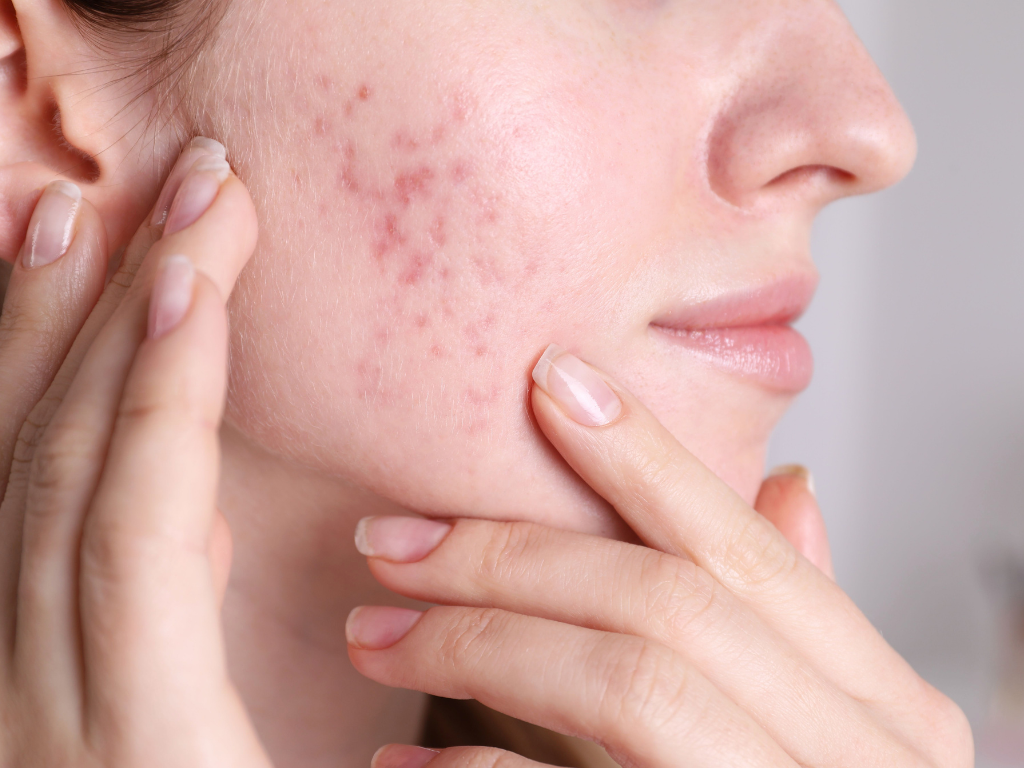
Flat red or brown marks change only skin colour, and the Dermatological Society of Singapore’s guidelines call them pseudoscars because they heal without lasting damage to the skin’s structure. If the surface feels smooth, our guide to acne marks versus acne scars is the better place to start.
The three types of atrophic acne scars
The ice pick, boxcar and rolling system comes from a 2001 classification by Jacob, Dover and Kaminer in the Journal of the American Academy of Dermatology. It remains the standard way dermatologists describe depressed acne scars.
| Scar type | Shape | Width | Depth and structure | Share of atrophic scars |
| Ice pick | Narrow, V-shaped tract with sharp margins | Under 2mm | Extends into the deep dermis or subcutaneous tissue | 60 to 70% |
| Boxcar | Round to oval depression, flat floor, sharp vertical edges | 1.5 to 4mm | Shallow boxcar 0.1 to 0.5mm; deep boxcar 0.5mm or more | 20 to 30% |
| Rolling | Broad depression with soft, sloping edges and a wavy surface | Widest, up to about 5mm | Skin tethered to deeper tissue by fibrous bands | 15 to 25% |
Ice pick scars
Ice pick scars look like small, deep punctures, as if the skin had been pricked with a sharp instrument. They are narrow at the surface but run down into the deep dermis or below, and that depth is what makes them the most stubborn type, resistant to conventional skin resurfacing.
A 2026 biopsy study in the Indian Journal of Dermatology, Venereology and Leprology measured scars directly in patients with skin of colour. Ice pick scars averaged about 1.9mm deep, significantly deeper than boxcar scars at about 1.3mm. Because of that depth, the literature pairs ice pick scars with focal techniques that work at the base of each scar, not with surface resurfacing alone.
Boxcar scars
Boxcar scars are wider, U-shaped depressions with steep, well-defined walls and a flat floor, often compared to chickenpox scars. Their depth is the deciding detail. Shallow boxcar scars of 0.1 to 0.5mm respond to skin resurfacing, while deep boxcar scars of 0.5mm or more resist it. Two boxcar scars that look alike from a distance can therefore need quite different approaches.
Rolling scars
Rolling scars are the broadest atrophic type, with gently sloping edges that give the skin a rippled or undulating look. They are caused by fibrous bands that anchor the dermis to the tissue beneath, pulling the surface down. That tethering explains why surface treatment alone changes rolling scars very little: the band underneath keeps pulling. Techniques such as subcision are designed to release it.
Their tethered nature also makes rolling scars distensible, meaning they tend to soften or flatten when the surrounding skin is gently stretched.

Raised acne scars: hypertrophic and keloid
Raised acne scars form when healing produces too much collagen. A hypertrophic scar stays within the boundary of the original spot and may flatten slowly over time. A keloid grows beyond that boundary into surrounding skin and can keep enlarging. They tend to favour the chest, shoulders, upper back and jawline, and the 1994 Leeds study found hypertrophic and keloid scarring on the trunk was significantly more common in men.
The Dermatological Society of Singapore’s guidelines note that Asian skin shows some distinctive acne scar patterns. These include keloids along the jawline, dumbbell-shaped or nodular keloids on the chest, and soft papular scars on the nose and chin that can resemble enlarged oil glands. Raised scars are managed very differently from depressed ones, and our page on keloid scars explains why they form and why they can return.
Most people have more than one scar type
Mixed scarring is the norm, not the exception. Someone with a history of inflammatory acne commonly has a combination of ice pick, boxcar and rolling scars across different areas of the face, sometimes alongside raised scars on the jawline or chest. That is why a plan built around one scar type rarely suits a real face.
A Brazilian series published in Dermatologic Surgery in 2003 shows the value of mapping scars first. Kadunc and Trindade de Almeida classified the scars of 228 patients by shape, then built staged treatment programmes matched to each patient’s scar types. Among the 168 who finished, 86% of patients rated their results excellent or good. Scars also often sit alongside leftover discolouration, and our article on how to fade dark marks from acne covers that separate problem.
How a dermatologist identifies scar type
Scar type cannot be judged reliably in a bathroom mirror. A dermatologist uses a few simple clinical steps to map what is there.
Side lighting, touch and the stretch test
Scars are examined under oblique side lighting, which casts shadows into depressions that flat overhead light hides. They are also felt and gently stretched. A rolling scar that softens or flattens under stretch points to tethering. An ice pick or deep boxcar scar that keeps its shape points to a structural defect that stretching cannot change. Standardised photographs are usually taken so changes can be compared over time.
Grading scar severity
Beyond type, scars are graded for severity. The Goodman and Baron qualitative scale, published in Dermatologic Surgery in 2006, uses four grades:
- Macular: flat red or brown marks with no change in contour
- Mild: scars not obvious from 50cm away and easily covered by makeup or beard shadow
- Moderate: scars obvious from 50cm away and not easily covered, but which flatten when the skin is stretched
- Severe: scars obvious from 50cm away that do not flatten when stretched
The Dermatological Society of Singapore uses a modified version in which flat marks count as grade 0 rather than grade 1, because they are not true scars.
Why scar type shapes the treatment plan
Matching treatment to scar anatomy is the reason classification exists. A surface laser cannot release a tether, and a tether release does little for a narrow ice pick tract. At Skincodes, Dr Ang Sue-May, who subspecialised in acne and acne scarring under Professor Tony Chu at Hammersmith Hospital in London, maps each patient’s scar types before recommending a staged plan. The options for acne scar treatment in Singapore are then matched to that map.
Preventing new acne scars
The most effective way to limit scarring is to treat acne properly and early. The 1994 Leeds study linked delays in adequate treatment to worse scarring, and inflamed papules can damage the skin’s structure as well as cysts. The Dermatological Society of Singapore recommends referral to a dermatologist for severe nodular or cystic acne. If breakouts are deep, persistent or already leaving dents, specialist acne treatment in Singapore protects the skin you have not yet lost. Scar revision usually waits until active acne is under control.
Conclusion
Ice pick, boxcar and rolling scars can look similar at a glance, but they differ in width, depth and structure, and raised scars form in the opposite way. Most faces carry a mix, which is why the scars need mapping before any device or procedure is chosen.
If you are not sure what type of acne scars you have, book a scar assessment with Dr Ang Sue-May to have them classified and graded first.
FAQs About Types of Acne Scars
What are the main types of acne scars?
Acne scars are either atrophic (depressed) or raised. The three atrophic types are ice pick, boxcar and rolling scars, which together make up more than 80% of acne scars. Raised scars are hypertrophic, which stay within the original spot, or keloid, which grow beyond it. Most people have a mix of types.
Which type of acne scar is hardest to treat?
Ice pick scars are generally the most stubborn. They are under 2mm wide but extend deep into the dermis or below, beyond the reach of surface resurfacing. Deep boxcar scars of 0.5mm or more are also resistant. Keloids are challenging for a different reason, because they can grow back after treatment.
How can I tell if I have ice pick, boxcar or rolling scars?
Look at width and edges under side lighting. Ice pick scars are tiny, deep pinpoints. Boxcar scars are wider with sharp vertical walls and a flat base. Rolling scars are broad with soft sloping edges and often soften when you stretch the skin. A dermatologist confirms type with lighting, touch and a stretch test.
What is the difference between boxcar and rolling scars?
Boxcar scars have sharp, vertical edges and a flat floor, like a small crater. Rolling scars have gentle, sloping edges and a wavy surface, and they are caused by fibrous bands tethering the skin to deeper tissue. Rolling scars usually soften when stretched; boxcar scars keep their shape.
What is the difference between hypertrophic and keloid acne scars?
Both are raised scars caused by excess collagen. A hypertrophic scar stays within the boundary of the original acne spot and may flatten over time. A keloid spreads beyond that boundary and can keep growing. In Asian skin, acne keloids commonly appear on the jawline and chest.
Do acne scars go away on their own?
True acne scars do not fade on their own. The Dermatological Society of Singapore’s guidelines state that post-acne scars cannot be reversed, but they can be made less noticeable. Flat red or brown marks are different: they are not scars and usually fade with time.
Can acne scars be prevented?
Early, effective acne treatment is the best prevention. A study of 185 acne clinic patients found that a delay of up to three years before adequate treatment was linked to worse scarring. It also found that superficial inflamed spots could scar as well as deep cysts. Avoid squeezing spots, and see a dermatologist for deep or persistent acne.