Mole removal at Skincodes starts with a dermoscopy check. The mole is assessed before anything is removed, and everything removed is sent for testing.
Most people come in because a mole is prominent on the face, catches on a collar or razor, or has started to bother them. Some come because it has changed, which takes priority.
Dr Ang Sue-May assesses, removes and reviews the pathology herself.
Keep the What Is Cosmetic Mole Removal section and both its paragraphs, moved to sit after Assessment Before Removal.
What Is Cosmetic Mole Removal?
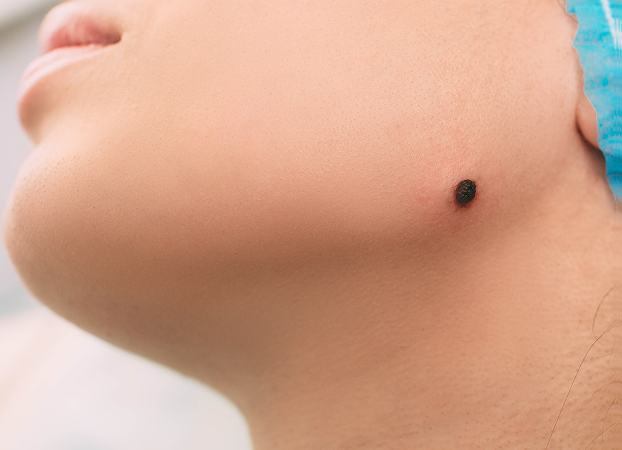
Cosmetic mole removal is the surgical removal of a benign mole – one that has been assessed as medically safe – carried out because the mole causes cosmetic concern or physical discomfort. Common reasons include a mole that is raised, conspicuous on the face or neck, prone to catching on clothing or jewellery, or simply one that the patient prefers to have removed.
Cosmetic mole removal at Skincodes is performed by Dr Ang Sue-May, a specialist dermatologist. This is a medical procedure, and it is approached with the same clinical rigour as any other skin surgery.
Understanding Moles
What moles are
Moles are collections of melanocytes, the cells that produce pigment in the skin,
clustered together. They can be flat or raised, vary in colour from pink to brown to
black, and may be present from birth or develop throughout life. While most moles
are harmless, changes in a mole’s appearance can be an early warning sign of
melanoma.
When a mole needs assessing
Any mole that changes in size, shape or colour, or begins to itch or bleed, requires
prompt assessment. So do moles with irregular borders, multiple colours or an
asymmetrical appearance. New moles appearing after the age of 30 warrant
evaluation.
When moles change
Moles may become more prominent or increase in number during pregnancy and
adolescence due to hormonal influences.
Monitoring instead of removing
For atypical moles, periodic dermoscopic photography allows changes to be detected
early without removing the lesion.
Method of Removal
The method used to remove a mole depends on its type, location, size, and depth.
Shave Excision
Raised or dome-shaped moles are often managed by shave excision, where the mole is carefully shaved to the level of the surrounding skin using a surgical blade. This technique does not require sutures and generally heals well, leaving a flat, faded mark.
Surgical Excision
Flat, pigmented, or deeper moles are typically removed by surgical excision, where the full depth of the mole is excised and the wound closed with sutures. This method allows the complete mole to be sent for histological review, which Dr Ang considers standard practice.
Dr Ang will advise on the most appropriate technique
after assessing the mole at your consultation.
Assessment Before Removal
Every mole should be assessed before removal – without exception.
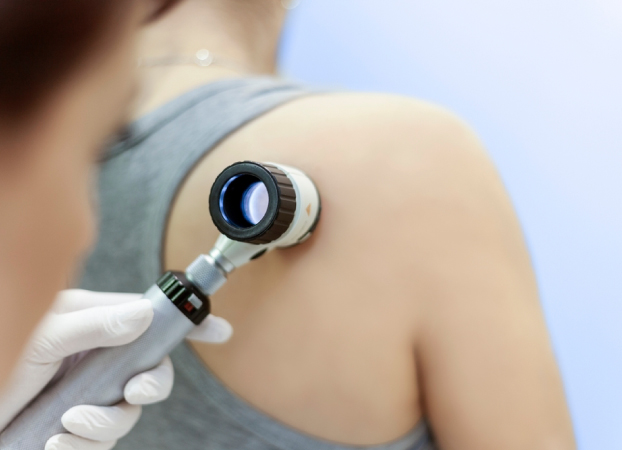
At Skincodes, each mole intended for removal is first examined clinically and with dermoscopy. This allows Dr Ang to evaluate the features of the mole and confirm that it is benign before any procedure is undertaken. If there is any concern about a mole’s characteristics, a biopsy may be recommended first, and removal will be carried out in a manner appropriate to the findings.
Cosmetic removal without prior assessment carries the risk of removing a lesion that may have required more careful management. We do not support that approach.

Healing and Scarring
All surgical procedures leave some degree of marking, and Dr Ang will discuss realistic healing expectations with you at your consultation.
Shave excision sites typically heal within two to three weeks, often fading to a pale flat area. Sutured excision sites heal over a similar period once sutures are removed, with scars continuing to mature and fade over several months. Healing varies depending on skin type, the site of the mole, and individual factors.
Patients with a history of keloid or hypertrophic scarring should inform Dr Ang at consultation, as this influences both the technique and aftercare plan.
Why Have a Mole Removed by a Dermatologist
Dermatological surgery performed by a specialist offers distinct advantages:
- Accurate pre-surgical diagnosis with dermoscopy. Lesions are assessed carefully as appearances can be misleading without specialist evaluation
- Appropriate margin assessment based on lesion type and clinical guidelines
- Histological analysis of all removed tissue to confirm diagnosis and clear margins
- Minimally invasive techniques selected to optimise cosmetic outcomes
- Structured follow-up and surveillance for ongoing skin health
Related at Skincodes
Common Questions About Mole Removal
Will removing a mole leave a scar?
Some mark is left wherever skin is cut. A shaved mole usually leaves a flat pale patch. An excised mole leaves a line. Placement and closure decide how noticeable it is.
Do all moles need to be tested?
Everything removed at Skincodes is sent for testing. It is the only way to be certain, and it costs nothing extra in time.
Can I have a mole removed for cosmetic reasons?
Yes, once it has been assessed as benign. That assessment comes first, every time.
Will the mole grow back?
A shaved mole can leave pigment cells behind and partially return. An excision removes the full depth and does not.
How many can be removed at once?
Several, depending on size and site. Dr Ang advises at the consultation, taking account of healing across multiple sites.
Does it hurt?
Local anaesthetic is used, so you feel pressure rather than pain. Mild soreness afterwards is normal for a day or two.