Home > Conditions > Skin Cancer Screening
Skin Cancer Screening & Treatment Singapore
A skin cancer screening is a full-body examination by a dermatologist, using a dermatoscope to look at moles and lesions under magnification. Anything suspicious is biopsied at the same visit.
Skin cancer is highly treatable when it is caught early. In Singapore the most common type is basal cell carcinoma, then squamous cell carcinoma, then melanoma.
Incidence is lower in Asian populations than in Western ones, and that is part of the problem. Patients here often come in at a later stage, when treatment is more complicated.
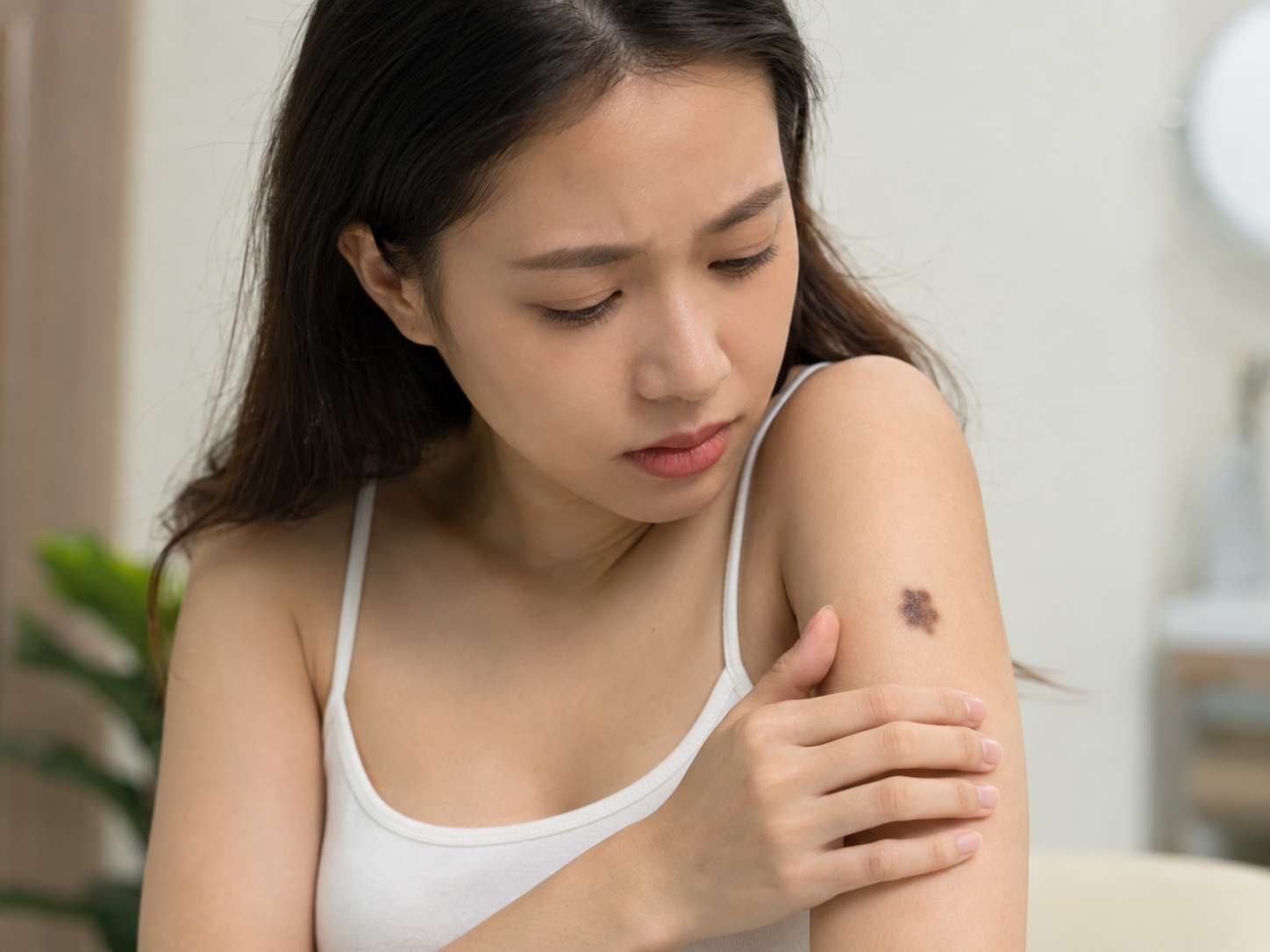
The ABCDE Check: How to Look at a Mole
Use this on any mole you are unsure about. One feature is worth a check. Two or more is worth booking.
A – Asymmetry: one half of the lesion does not match the other
B – Border: irregular, ragged, notched, or blurred edges
C – Colour: variation within the lesion, multiple shades of brown, black, red, or white
D – Diameter: lesions larger than 6mm, or growing
E – Evolution: any change in size, shape, colour, or behaviour, including bleeding, crusting, or itching
Other things worth checking
A new mole appearing after the age of 30. A sore that will not heal. A shiny, pearly nodule, which is typical of basal cell carcinoma.
Where Melanoma Appears on Asian Skin
In Asian patients, melanoma most often shows up on the palms, the soles of the feet and under the nails, rather than on sun-exposed skin.
These are the places nobody checks, which is why self-examination misses the thing that matters. A dark streak under a nail that widens over months, or a new dark patch on the sole, needs looking at.
A full-body check at Skincodes includes hands, feet and nails every time.
In acral melanoma, genetic factors appear to play a greater role than UV exposure.

Causes & Risk Factors
Cumulative UV radiation exposure, from sunlight and artificial tanning devices
Fair skin and a history of sunburn
Family or personal history of skin cancer
Immunosuppression
Long-term immunosuppressive medication, including after an organ transplant, raises the risk of both squamous cell carcinoma and melanoma. Regular screening is worth building into the routine.
Chronic skin trauma or scarring
Skin cancers can develop in old burns, long-standing ulcers and scars that never fully healed. Any non-healing area at a site of past injury is worth assessing.
Assessment and Treatment at Skincodes
Skin Screening and Mole Checks
A thorough whole-body skin examination to identify any lesions warranting closer attention. Dr Ang uses dermoscopy to assess moles and skin lesions with detail that the naked eye cannot provide.
Dermoscopy
A non-invasive technique that allows detailed visualisation of lesion structures beneath the skin surface, improving diagnostic accuracy significantly.
Biopsy
Where indicated, a tissue sample is taken for histological analysis to confirm the diagnosis.
Surgical Excision
The primary treatment for most skin cancers, performed with appropriate margins to ensure complete removal.
Surveillance and Follow-Up
Patients with confirmed skin cancer or atypical moles are monitored on a structured review schedule.
If you have a changing or suspicious lesion, get it looked at early.
A timely consultation means an accurate diagnosis and, if treatment is needed, the simplest version of it.
Who Should Have a Skin Check, and How Often
Book a check now if
- A mole has changed in size, shape or colour
- A spot bleeds, crusts or will not heal
- A dark streak has appeared under a fingernail or toenail
- A new mole has appeared after the age of 30
Consider annual screening if
- You or your family have a history of skin cancer
- You have many moles, or moles that look irregular
- You take long-term immunosuppressive medication
- You get a lot of sun through work or sport
What the appointment involves
A full-body examination under good light, with a dermatoscope for anything of concern. It does not hurt and needs no preparation. If a lesion needs a biopsy, that is usually done at the same visit under local anaesthetic.
Why Diagnosis and Surgery
Should Be the Same Consultant
Dermatological surgery performed by a specialist offers distinct advantages:
- Accurate pre-surgical diagnosis with dermoscopy. Lesions are assessed carefully as appearances can be
misleading without specialist evaluation - Appropriate margin assessment for cancer excisions based on lesion type and guidelines
- Histological analysis of all removed tissue to confirm diagnosis and clear margins
- Minimally invasive techniques selected to optimise cosmetic outcomes
- Structured follow-up and surveillance for ongoing skin health
Common Questions About Skin Checks
How often should I have a mole check?
For most people with no risk factors, when something changes. Annual screening is worth considering if you or your family have a history of skin cancer, if you have many or irregular moles, if you are on long-term immunosuppression, or if you get heavy sun exposure. Your dermatologist sets the interval after the first check.
Does a mole check hurt?
No. A dermatoscope is placed against the skin and nothing is cut or removed. If a lesion needs a biopsy, that is done under local anaesthetic, usually at the same visit.
Is skin cancer common in Singapore?
Less common than in Western countries, but it happens and it is often found later here. Melanoma in Asian patients more often appears on the palms, soles and under the nails rather than on sun-exposed skin, which is why it gets missed.
What happens if a mole looks suspicious?
It is biopsied. Part or all of the lesion is removed under local anaesthetic and sent to the lab. The result decides whether anything else is needed. At Skincodes the consultant who assessed the lesion is the one who performs the procedure.
Do I need a referral for a mole check?
No referral is needed to book at Skincodes. If you are going through a subsidised specialist clinic in the public system, you will need one from a polyclinic or GP for that.